BACK TO EXPLORE
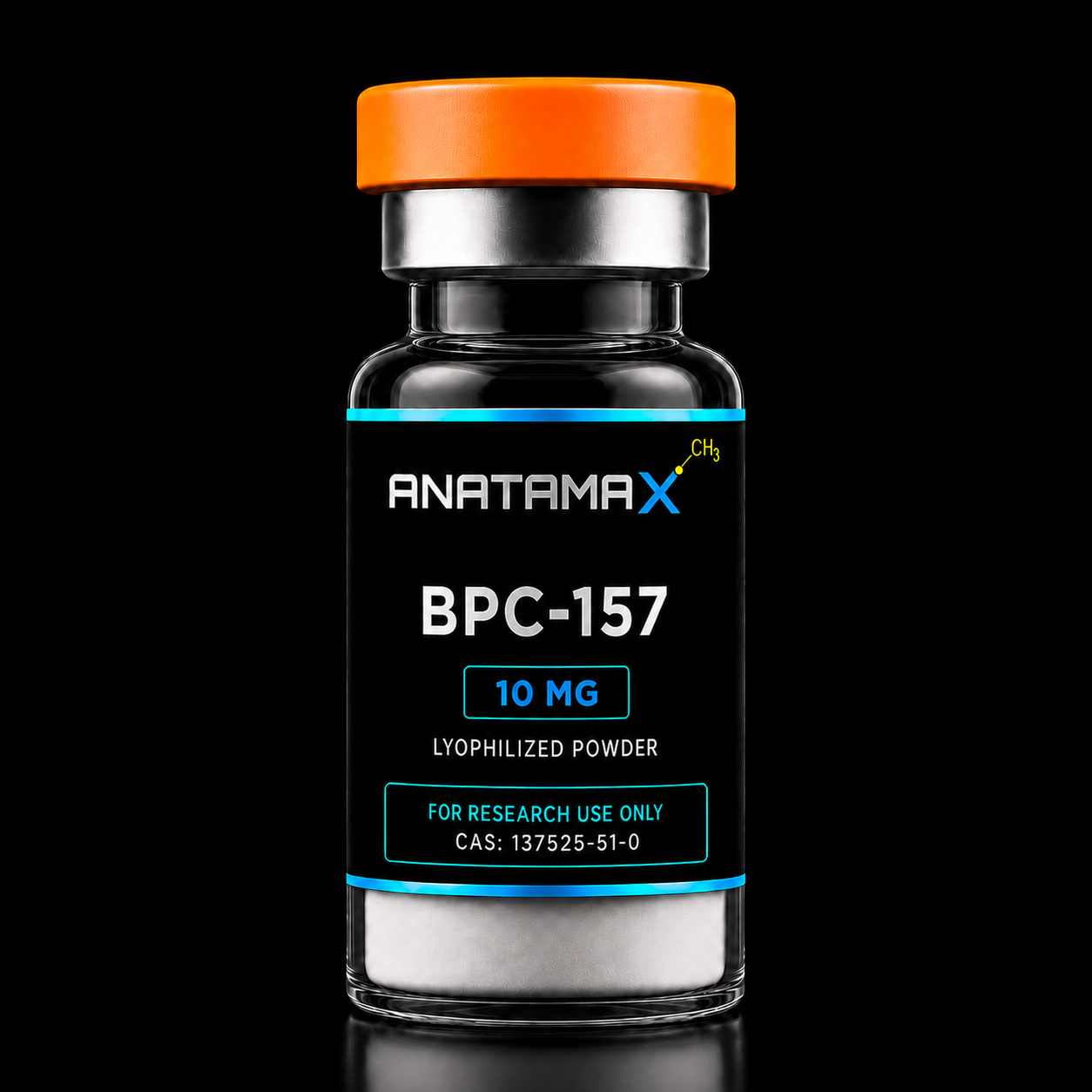
BPC-157 vial
LYOPHILIZED PEPTIDE · PENTADECAPEPTIDE

BPC-157

Body Protection Compound — 157

Synthetic pentadecapeptide fragment derived from a gastric protein sequence.

Format
Lyophilized powder, single-use vial
Availability
IN STOCK
FOR RESEARCH USE ONLY · NOT FOR HUMAN CONSUMPTION
Bundle
Total
$60
VIEW CART
QUICK SPECIFICATIONS
CAS
137525-51-0
Molecular weight
1419.55 g/mol
Molecular formula
C₆₂H₉₈N₁₆O₂₂
Purity
≥ 99% by HPLC
Format
Lyophilized powder
Storage
−20 °C, light-protected
PRIMARY SEQUENCE · 15-MER
15 RESIDUES · SCROLL TO SCAN
G
Glycine
Gly · Position 1 / 15 · Nonpolar
Nonpolar
Polar
Acidic
Basic
Aromatic
STRUCTURAL DESCRIPTION

BPC-157 is a 15-amino-acid synthetic peptide originally identified as a fragment of a protein found in gastric juice. It is widely used in preclinical studies investigating tissue-repair signalling pathways, vascular remodelling, and gastrointestinal physiology.

The sequence is unusually proline-rich (4 of 15 residues), giving the chain a constrained backbone that resists enzymatic degradation in acidic conditions. The N-terminus carries a free glycine; the C-terminus ends in valine.

RESEARCH CONTEXT
  • + Studied in animal models of soft-tissue and mucosal injury.
  • + Frequently paired with TB-500 in regenerative research literature.
  • No approved clinical use. Not a drug. Not for diagnosis or treatment.
  • No dosing, reconstitution, or administration guidance provided.
MECHANISM IN RESEARCH CONTEXT

Pathways under study

Nitric-oxide system

eNOS pathway modulation has been described in vascular and gastric tissue preparations.

VEGFR-2 signalling

Receptor expression and angiogenic markers studied in injury-site models.

Growth-factor expression

Reports of altered FGF, EGF, and collagen-related gene expression in repair models.

RESEARCH-MODEL COVERAGE

Where it appears in the literature

Tendon & ligament

Rodent Achilles and quadriceps transection models — collagen organisation, fibroblast outgrowth.

Skeletal muscle

Crush and strain models — angiogenic markers, regeneration timeline.

Mucosal / GI

Gastric and esophageal lesion models — original context of the parent protein.

Vascular

Endothelial NO synthase pathway studies; VEGFR-2 expression in injury sites.

CNS

Neural-regeneration literature exploring dopaminergic and serotonergic systems.

Connective tissue

Skin wound and cartilage models, granulation tissue formation.

Storage

Lyophilized powder is stable long-term at −20 °C, light-protected, in original sealed vial.

Transport

Ships ambient. Lyophilized form tolerates short transit windows without cold chain.

Quality

Every lot is HPLC-tested to ≥99% purity with mass spectrometry confirmation and lot tracking.

SELECTED LITERATURE

References

Provided for research context only. Inclusion does not imply any claim about the product or its use.

  • Pentadecapeptide BPC 157 and the central nervous system
    Sikiric et al., Neural Regen Res, 2022
  • BPC 157 — A novel cytoprotective peptide with potential therapeutic applications
    Seiwerth et al., Curr Pharm Des, 2018
  • Stable gastric pentadecapeptide BPC 157 and tendon-to-bone healing
    Krivic et al., J Orthop Res, 2006
  • BPC 157 enhances the healing of transected rat Achilles tendon
    Staresinic et al., J Orthop Res, 2003
  • BPC 157 and nitric-oxide system in cardiovascular research
    Vukojević et al., Inflammopharmacology, 2018
FOR RESEARCH USE ONLY · NOT FOR HUMAN OR VETERINARY USE · NOT FOR DIAGNOSTIC OR THERAPEUTIC USE